Knowledge hub
You can sleep eight hours — and still barely recover
Stress itself is not unhealthy. What matters is whether the body switches back to recovery afterwards. Medical-grade ECG and HRV show why.

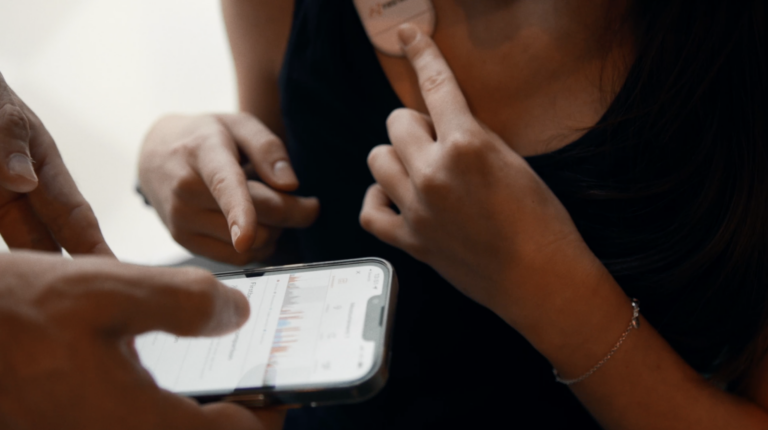
We have grown used to wearables that measure almost everything. Steps, heart rate, sleep, activity and sometimes even a stress score. That is valuable. But when you really want to understand what prolonged mental load does to someone, a smartwatch alone is often not enough.
That is why MentalCareDirect works with a medical-grade ECG device that measures heart rate and heart rate variability, HRV, over several days. Not to give employees even more numbers, but to better understand how strain and recovery relate to each other throughout the day and night.
Stress is not the problem
Stress has a bad reputation, but stress itself is not unhealthy. We need stress responses to perform, concentrate, meet deadlines and respond adequately to what happens around us.
It becomes interesting when the body afterwards does not switch back enough. You can compare it to a battery. During the day we use energy. Work pressure, meetings, deadlines, worries at home, sports and other intensive activities all demand something from our system. Recovery is the moment that battery is recharged.
The key question is therefore not just: how much stress does someone have? But above all: is the body recovering enough from that strain?
Why do we look at HRV?
Many wearables mainly measure heart rate. That says a lot about exertion, but not the whole story. That is why we also look at Heart Rate Variability, or HRV: the small differences in time between consecutive heartbeats.
A healthy heart does not beat like a metronome. That variation provides information about how the autonomic nervous system responds to strain and recovery. The balance between the sympathetic nervous system, which activates us, and the parasympathetic nervous system, which is involved in rest and recovery, plays an important role.
That is why HRV can provide extra insight into what is happening physiologically.
Why ECG and not just a smartwatch?
Most smartwatches measure heart rate optically, using light on the underside of the watch. That is convenient and suitable for daily use and long-term trends. But it remains an indirect measurement.
Our medical-grade ECG device records the heart's electrical activity via electrodes. This allows the intervals between heartbeats to be measured much more accurately. And that accuracy matters when you want to look at subtle patterns in strain, recovery and HRV.
That does not mean a smartwatch is worthless. On the contrary. A wearable and an ECG measurement simply have a different purpose. A smartwatch is excellent for daily monitoring and trends. Our multi-day ECG measurement is intended as a targeted deepening.
Not continuous measurement, but targeted observation
More data does not automatically mean more insight. That is why we consciously choose measurements over a number of representative days. Workdays and nights. During meetings, travel, sports, moments at home and during sleep.
This creates a picture of how the body actually responds to daily life. Sometimes that shows something different than someone expects.
Sleeping is not the same as recovering
Someone can lie in bed for eight hours and still wake up tired. Conversely, someone can sleep relatively briefly and feel surprisingly good. So the number of hours slept does not tell the whole story.
The more interesting question is: does the body actually enter recovery during the night? By looking at physiological patterns, we gain more insight into the relationship between daytime strain and nighttime recovery. And that is where important differences can become visible.
Two people, the same day, totally different response
Imagine: two employees have the same busy workday. The same meetings, deadlines and working hours. Yet their bodies can respond very differently. One employee switches back relatively quickly after an intensive consultation. With the other, the body remains activated for a long time. One recovers well at night, the other's recovery remains limited.
That does not automatically mean someone is ill or will drop out. But it can be a reason to look further. And that is exactly where prevention begins. Not predicting who will drop out. Not labelling someone. But recognising earlier when strain and recovery start to get out of balance.
Measurement only makes sense if you do something with it
For MentalCareDirect, the ECG measurement is never the end point. It is the beginning of a conversation. What happened at moments when the strain was remarkably high? When did recovery occur? What does the night look like? What role do work pressure, exercise, relaxation, travel time, worrying or other circumstances play?
And above all: what can we change? Sometimes it is relatively small adjustments. Sometimes coaching is useful. And sometimes it is wise to talk to a psychologist or other professional more quickly. It is precisely the combination of objective measurement, interpretation and actual support that makes the measurement valuable to us.
Technology is not the goal
An ECG measurement cannot tell what someone is thinking. It does not tell why someone is sad. It does not make a psychological diagnosis. And it does not replace a psychologist. But it can make visible something that people do not always feel or recognise themselves: how the body responds to the life someone leads.
Mental overload usually does not happen overnight. It builds up. That is why we believe the future of mental health care lies not only in helping when someone drops out. But also in: looking earlier. Understanding earlier. Helping earlier.
Curious how we set up these measurements and the conversations that follow? It is described on our prevention page.
Keep reading
Prevention · 10 September 2026
In the news today: what happens at home does not stay at home
Research by MKB-Nederland and ArboNed shows that personal circumstances play a major role in sick leave. What does that mean for employers?
Prevention · 4 September 2026
Can you measure yourself awake?
When your sleep score matters more than how you feel. On orthosomnia, wearables and the difference between measuring for insight and chasing a perfect number.