Knowledge hub
Can you measure yourself awake?
When your sleep score matters more than how you feel. On orthosomnia, wearables and the difference between measuring for insight and chasing a perfect number.

Prompted by something we heard on BNR Radio today.
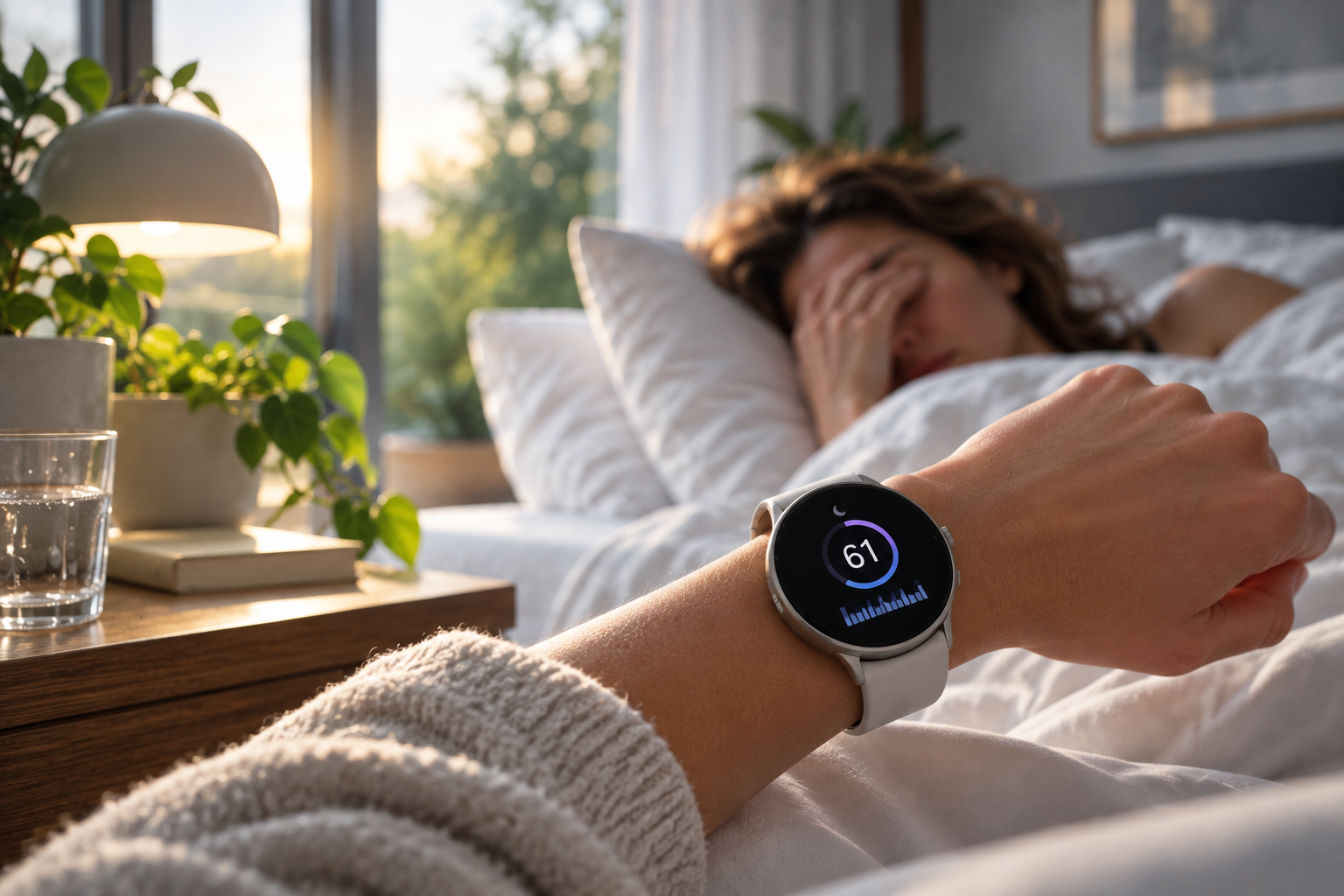
You wake up. You actually feel pretty good. You slept well. And then you look at your smartwatch. Sleep score: 61. Too little deep sleep. Awake too often. Your recovery was mediocre. And suddenly that perfectly fine night feels a lot less fine.
Sound familiar? Then you have met an interesting phenomenon: orthosomnia.
What is orthosomnia?
The term orthosomnia was introduced in 2017 by sleep researchers to describe people who are so focused on measuring and optimising their sleep that the pursuit of perfect sleep starts to work against them.
Smartwatches, smart rings and other wearables now give us an impressive amount of information every morning. How long did we sleep? How much deep sleep did we get? How much REM sleep? How often did we wake up? And of course: what is our sleep score?
That can be interesting information. But a problem arises when we start trusting the number more than our own body.
“My watch says I slept badly”
Sleep scientist Merijn van de Laar warns about this effect. Consumer wearables can give a reasonable estimate of sleep and wake time, but determining individual sleep stages, such as deep sleep and REM sleep, is considerably harder. Yet we easily treat the result as if it were a medical test outcome.
Something curious can then happen. You wake up reasonably rested, but your wearable tells you that you slept badly. You start paying attention to your fatigue. Maybe you go to bed earlier that evening. You try extra hard to sleep. The next morning you check your score again.
And that is exactly where the paradox sits. Sleep is not something we can force. The harder we try to sleep well, the more important sleep becomes. And the more important it becomes, the more tension a bad night can cause. That tension can in turn make falling and staying asleep harder. The sleep tracker meant to improve your sleep can unintentionally become part of the problem.
Measuring is not the problem
That does not mean measuring is wrong. On the contrary. At MentalCareDirect™ we strongly believe in objective measurement. ECG and HRV measurements can reveal patterns in strain, recovery and the workings of the autonomic nervous system that someone does not always notice themselves. You can read how we do that on our prevention page.
But there is an essential difference between measuring to gain insight and measuring to chase a perfect number. A measurement should be a tool to understand a person better. Not a grade that dictates how someone ought to feel.
Data only gain meaning when placed in context. How do you feel? How do you function during the day? What does your workload look like? How do you recover? And above all: what do we see over a longer period? One bad score is not a bad night. And one bad night is certainly not a health problem.
Maybe we should listen to ourselves a little more again
We have increasingly good technology to measure our bodies. That offers enormous possibilities for prevention and early detection. But technology also has a downside when we try to optimise every number.
So perhaps the most important question in the morning is not “What was my sleep score?” but “How do I feel today?”
Because in the end technology should help us listen to our body better, not make us lose trust in it.
Sources and background: Baron, K.G. et al. (2017), Orthosomnia: Are Some Patients Taking the Quantified Self Too Far?, Journal of Clinical Sleep Medicine (published via PubMed). Merijn van de Laar, sleep scientist and licensed healthcare psychologist, publications and interviews on sleep and the use of sleep trackers. Research into cognitive and physical arousal and its relation to insomnia and sleep quality.
Keep reading
Prevention · 10 September 2026
In the news today: what happens at home does not stay at home
Research by MKB-Nederland and ArboNed shows that personal circumstances play a major role in sick leave. What does that mean for employers?
Prevention · 1 September 2026
We measure blood pressure and cholesterol. Why not mental load?
HRV and medical-grade ECG provide objective insights into strain and recovery. Not a diagnosis, but a starting point for an earlier conversation.